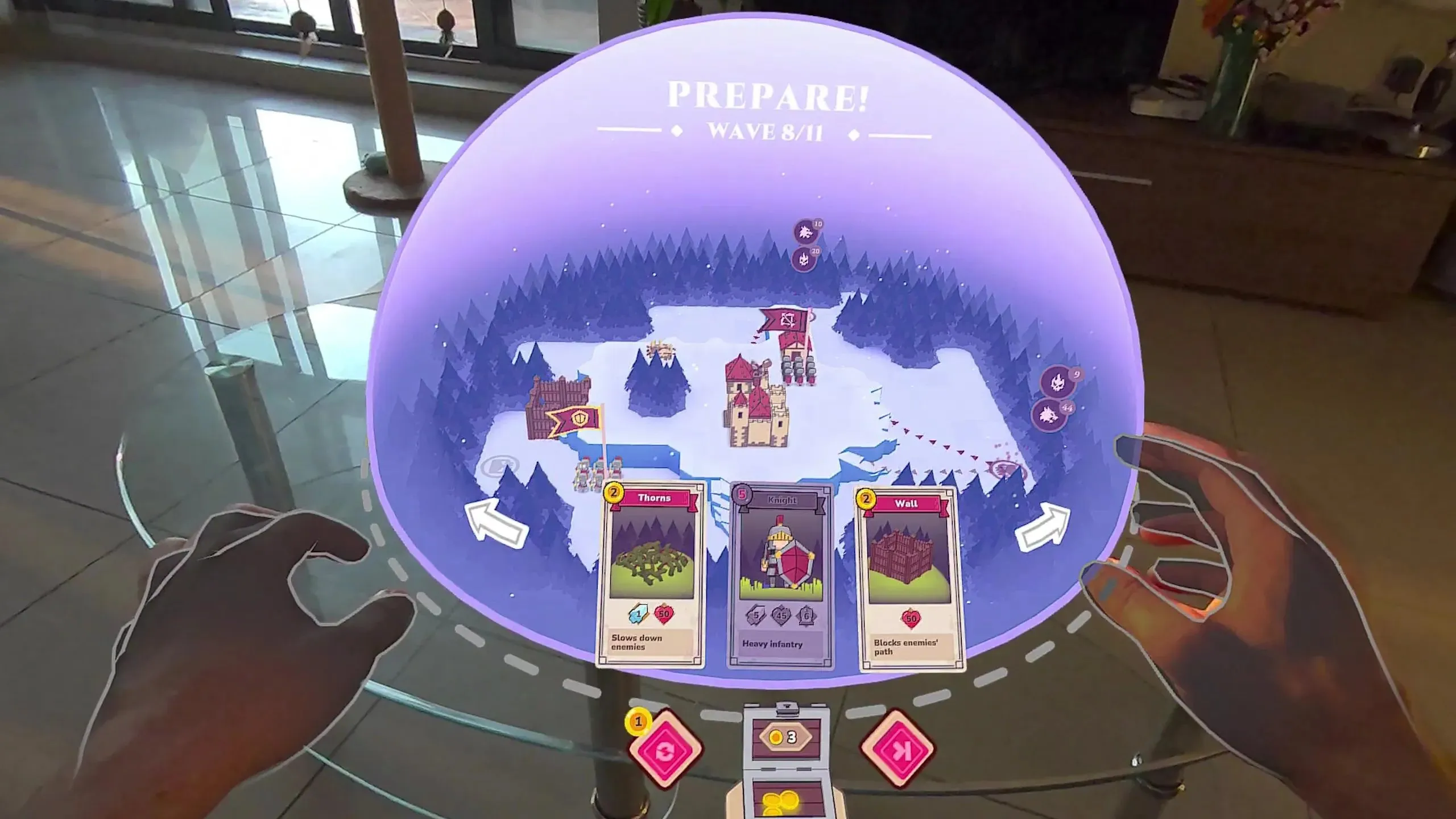

Today, our company Exir Games and our latest title, Banners & Bastions, have passed 15,000 users with a 4.8-star rating on the Meta Quest Store. We’re a small team based in Finland, and we’re focused on one thing: making XR mainstream and accessible to anyone.
It wasn’t always like this. Not long ago, we were a mobile game studio with tens of millions of downloads and a profit line that had dropped below zero. This post is the written version of my talk at GameCraft Amirkabir about how we got from there to here: why we left mobile, why we bet on mixed reality, how we started, and what we learned on the way.
Two years ago: 60 million downloads, and a problem
Back then, our mobile studio, Dropout Games, had passed 60 million downloads, with 80,000 to 100,000 daily active users on average.
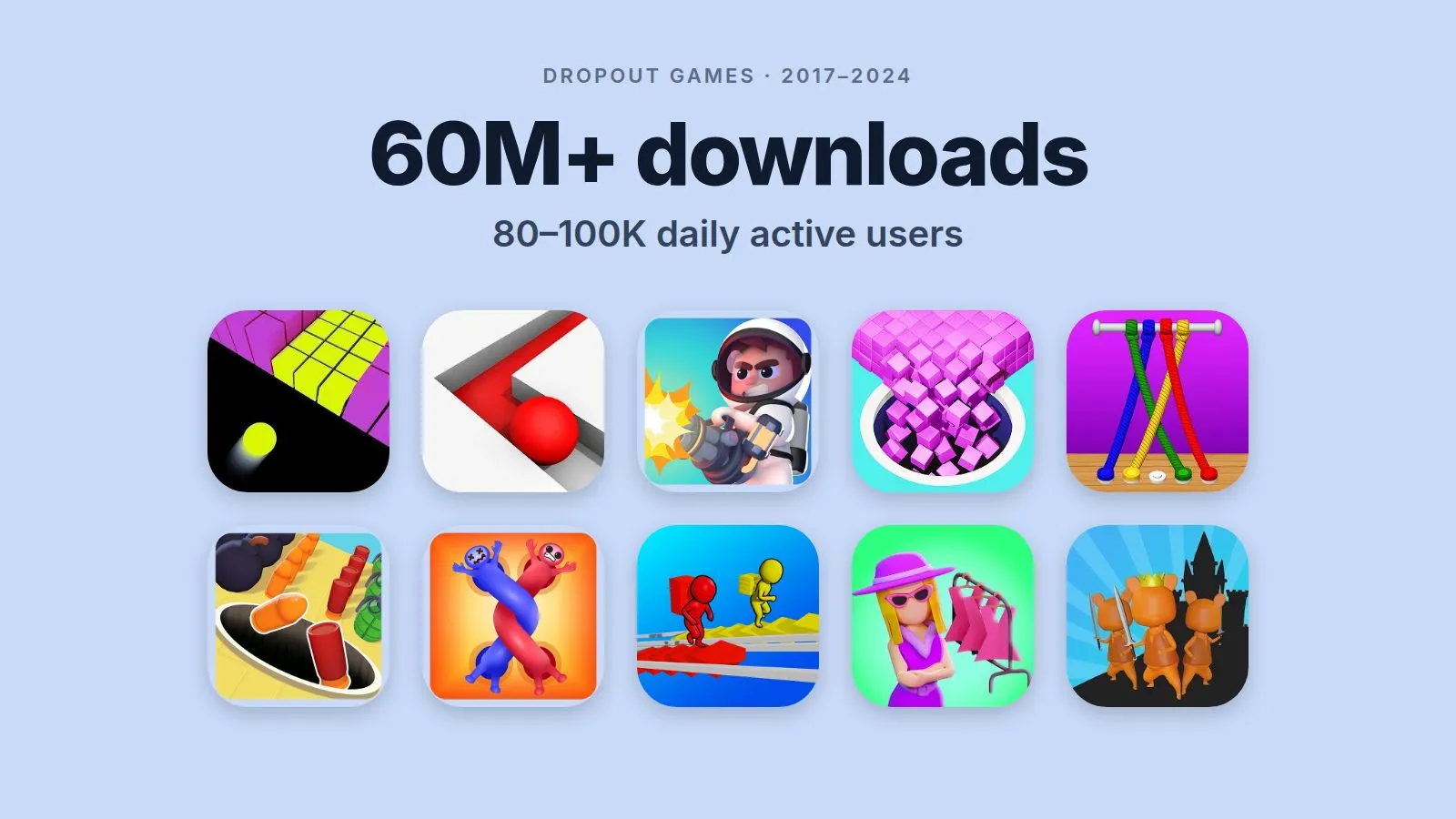
But there was a big problem: our profit was declining.
We started making mobile games in 2017. Our first income came from hyper-casual games on Cafe Bazaar, the Iranian app store. Then came real success on Google Play with titles like Color Crush, Color Maze and Untangle, and an even bigger peak when we launched those games on Google Play Instant. We made enough profit to buy an office and move the whole team from remote to on-site work.
Then we started our next big title, Last Survivor. We worked on it for more than a year to make it profitable. It never was. After that, we tried to repeat our old hyper-casual formula. Every attempt failed.
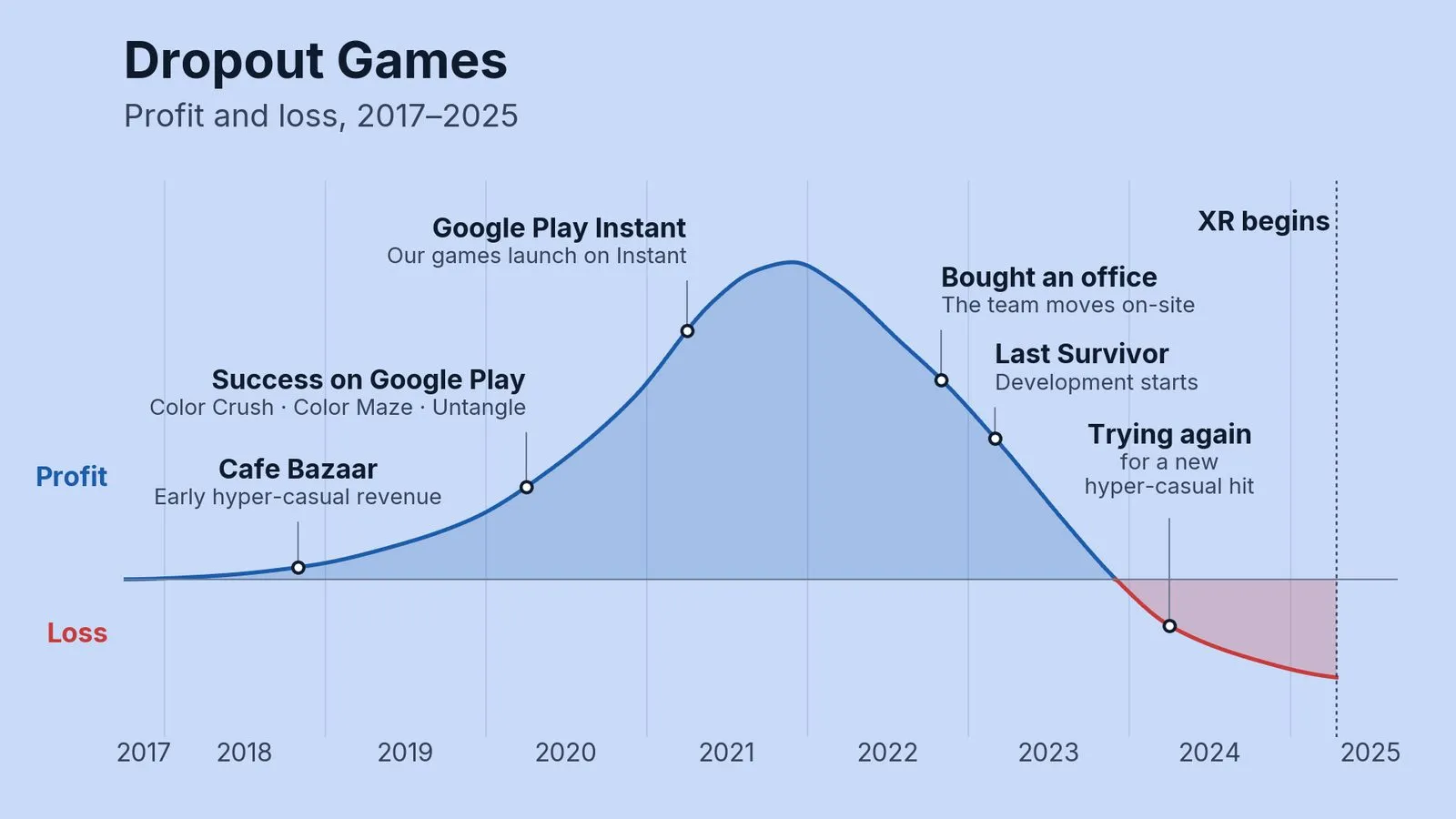
That’s when the real question came up: is mobile game development what we should keep doing?
Why we left mobile, and why mixed reality
So we took a big risk: pivoting to a completely new platform.
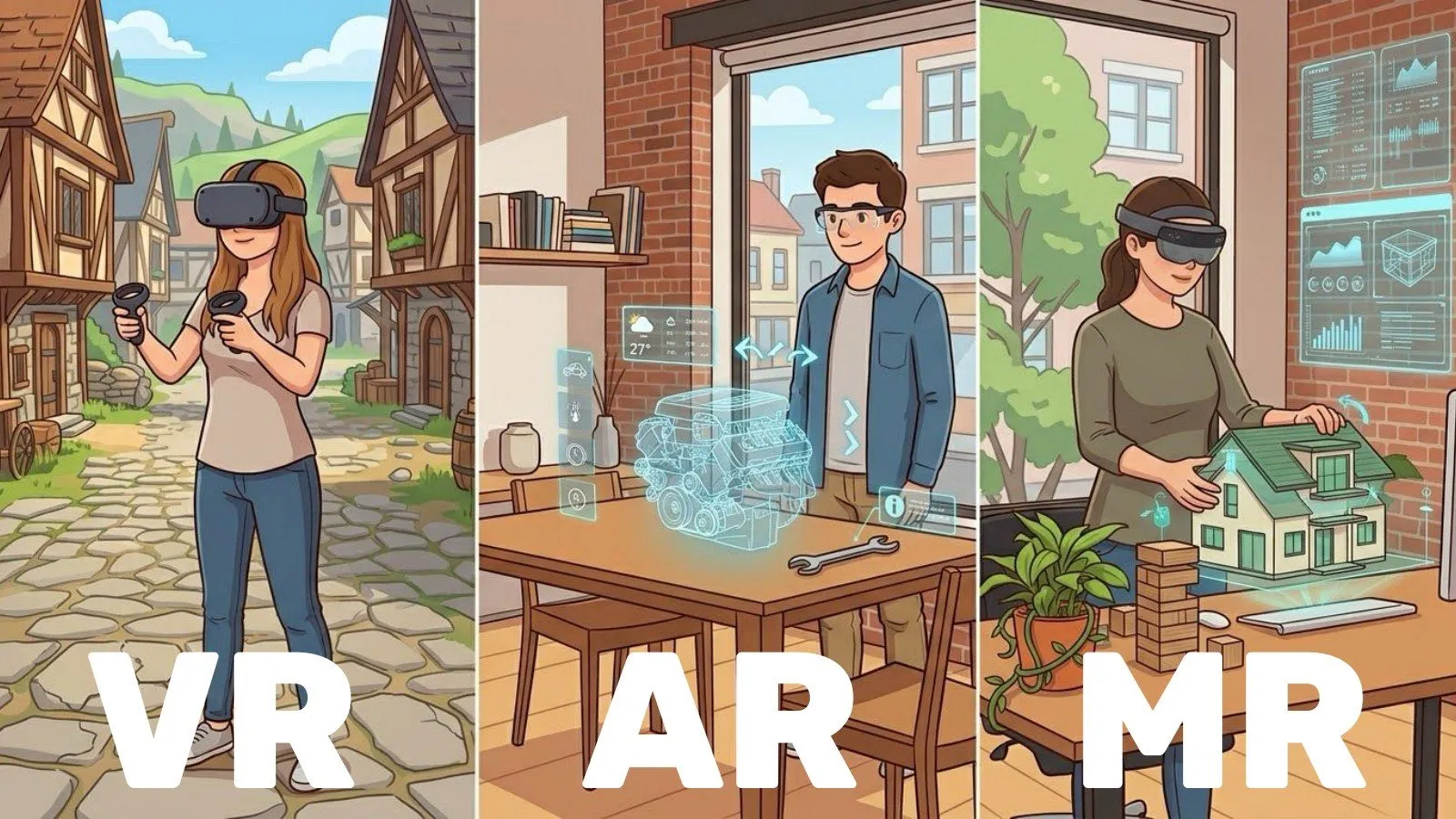
A quick explanation first. In VR (virtual reality), you’re placed in a completely virtual world. AR (augmented reality) adds virtual elements to your world, mostly through flat screens. MR (mixed reality) blends virtual elements with the world around you, so you feel them coming into your real life. Banners & Bastions is a mixed reality game: the battlefield sits on your real table.
Three comparisons explain why we moved.
A red ocean and a blue ocean
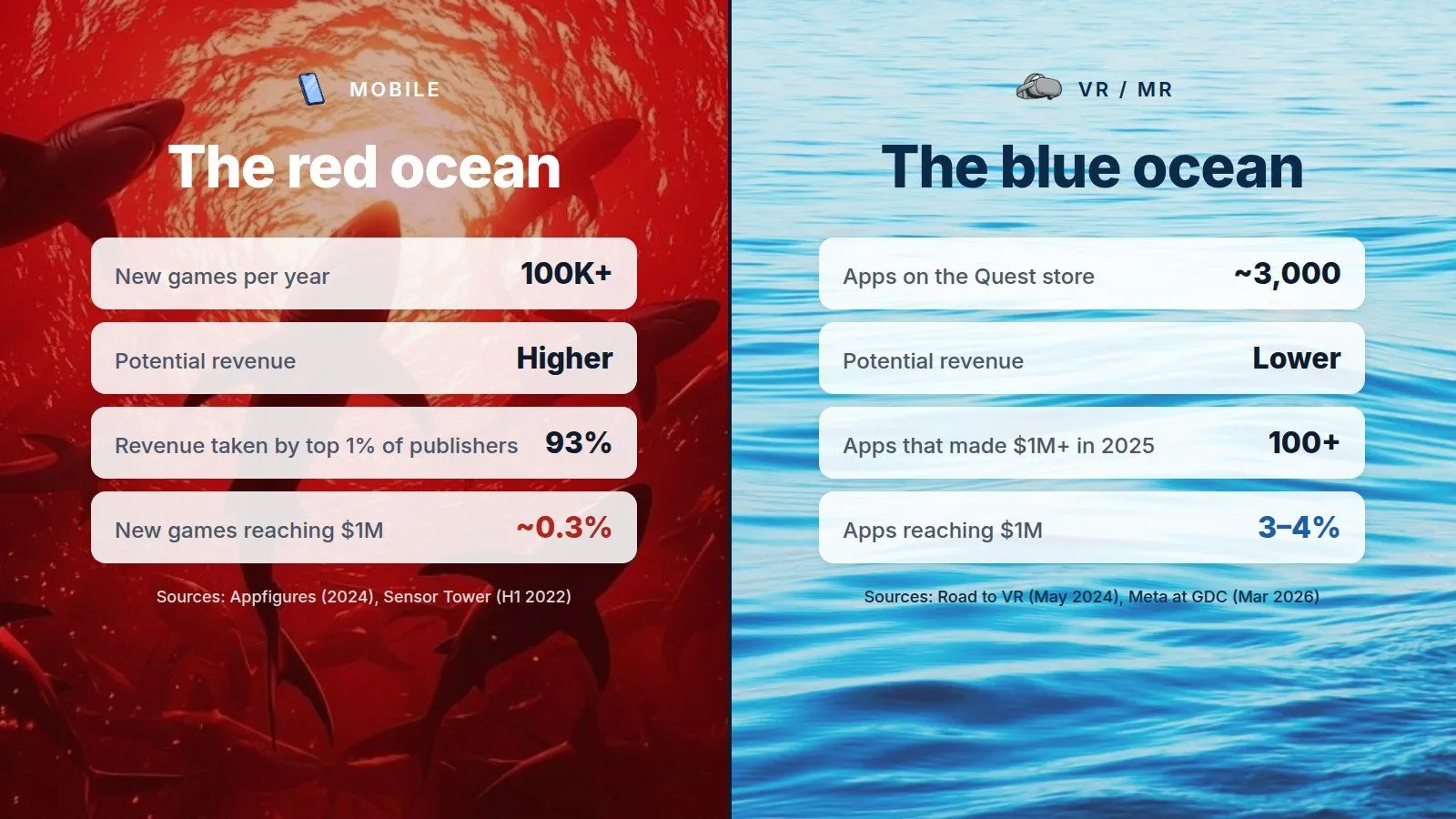
Working in the mobile industry was like swimming in a red ocean full of huge, hungry sharks that left you no food. Over 100,000 new mobile games launch every year (126,000 in 2024 alone). In 2022, the top 1% of publishers took 93% of all revenue. And using $1 million in revenue as the yardstick, only about 0.3% of the games released in 2024 reached it.
The Quest store, which includes both VR and mixed reality apps, has around 3,000 apps, and more than 100 of them made over $1 million in 2025. That’s about 3–4%. The potential revenue is smaller, but the odds are roughly ten times better.
There’s no separate store for mixed reality: MR games like ours sit in the same Quest store as VR games, so these are the odds we actually compete in.
Following trends, or creating them
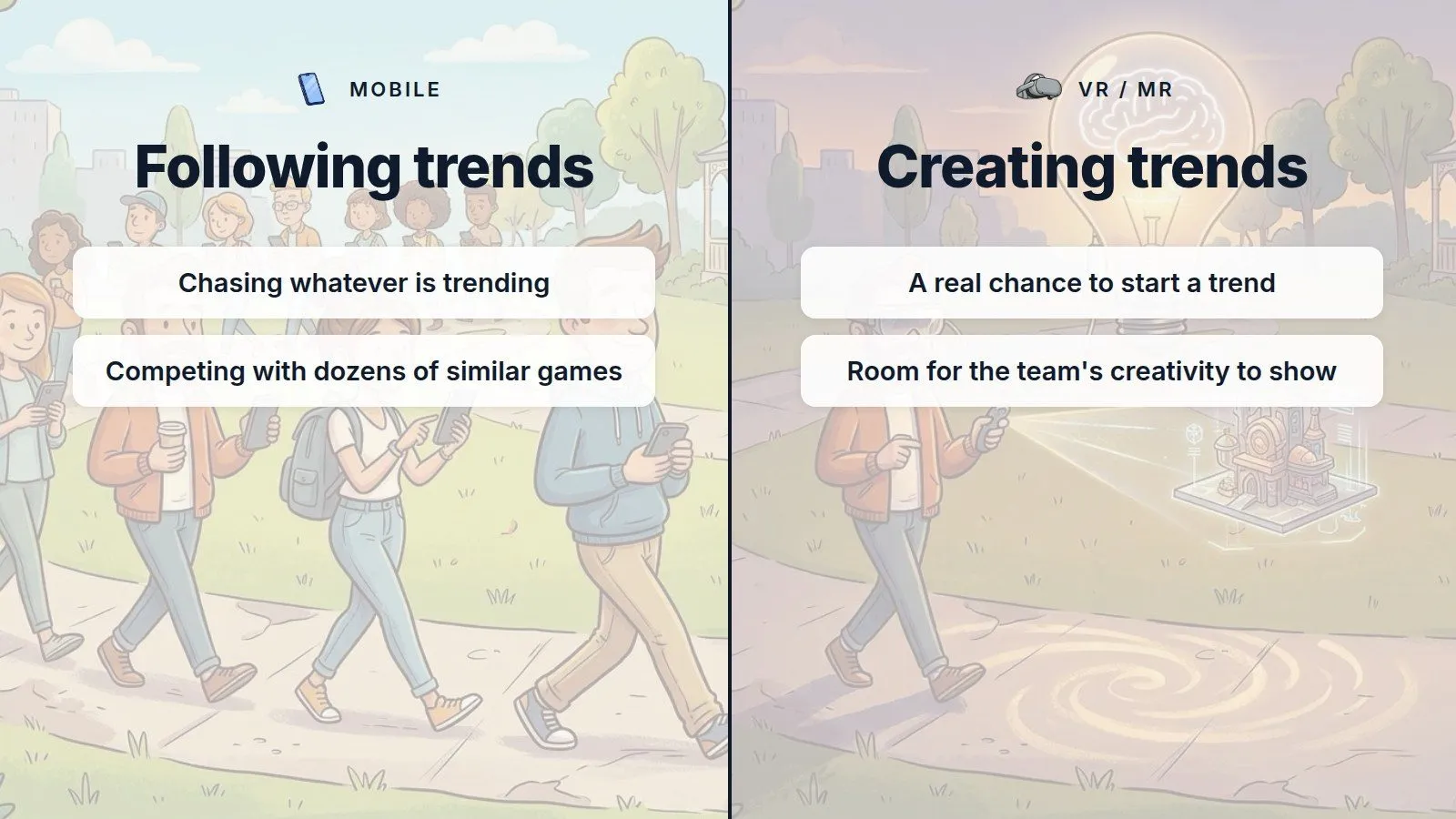
In mobile, we always had to follow the trends. The moment we had a new idea, we knew we’d be competing with dozens of similar games built on the same idea.
In MR, we have the chance to create a trend. Our team finally had room to be creative and to push the borders of what mixed reality can do.
A market in middle age, and one in its early teens
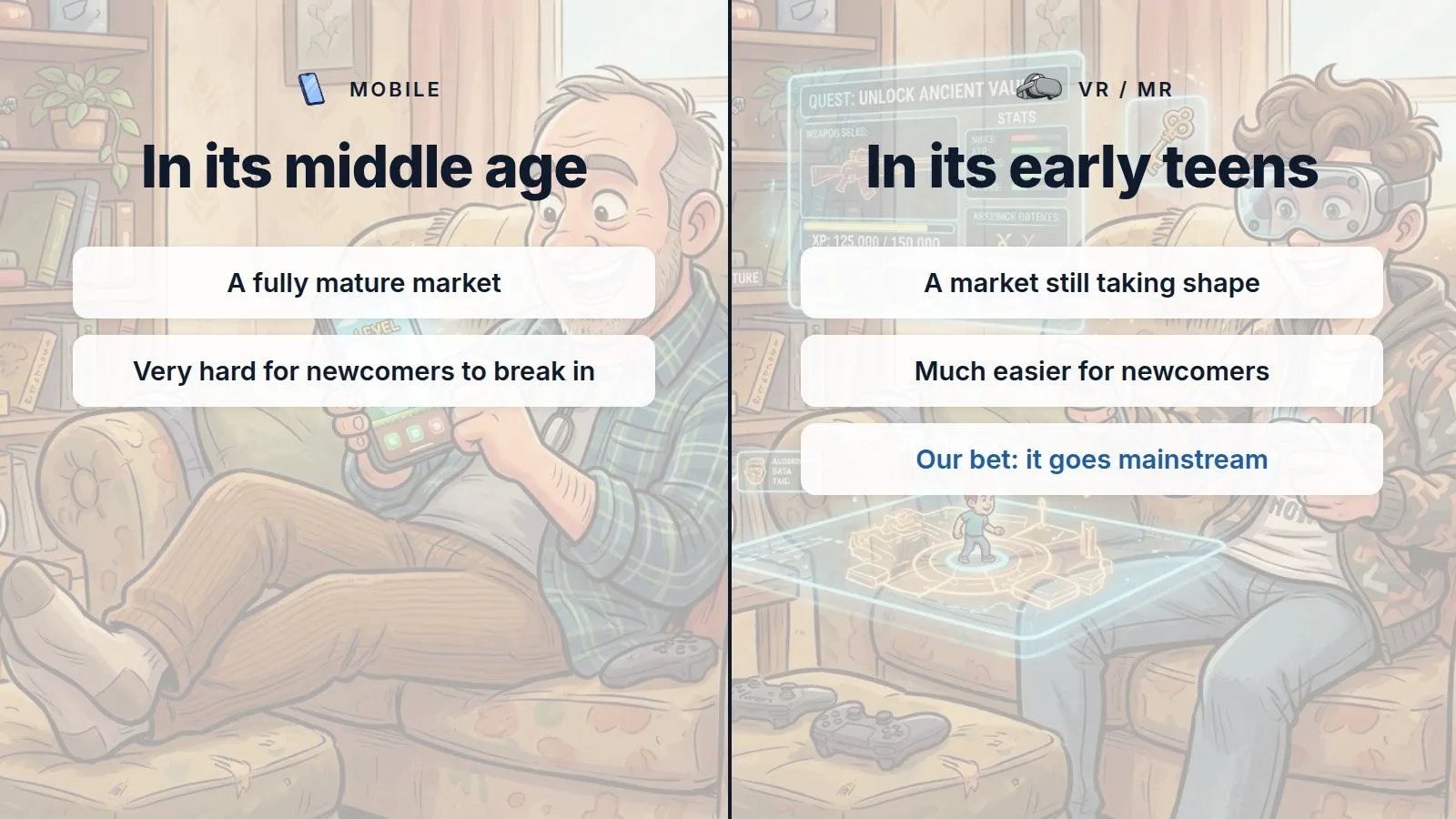
The mobile games boom took off around 2012. Today it’s a mature market, and there’s very little room left for newcomers.
Mixed reality is still taking shape, so it’s much easier to get in. We made a bet: MR will take off in the next five years, and we want a larger share of it when it does.
How we started
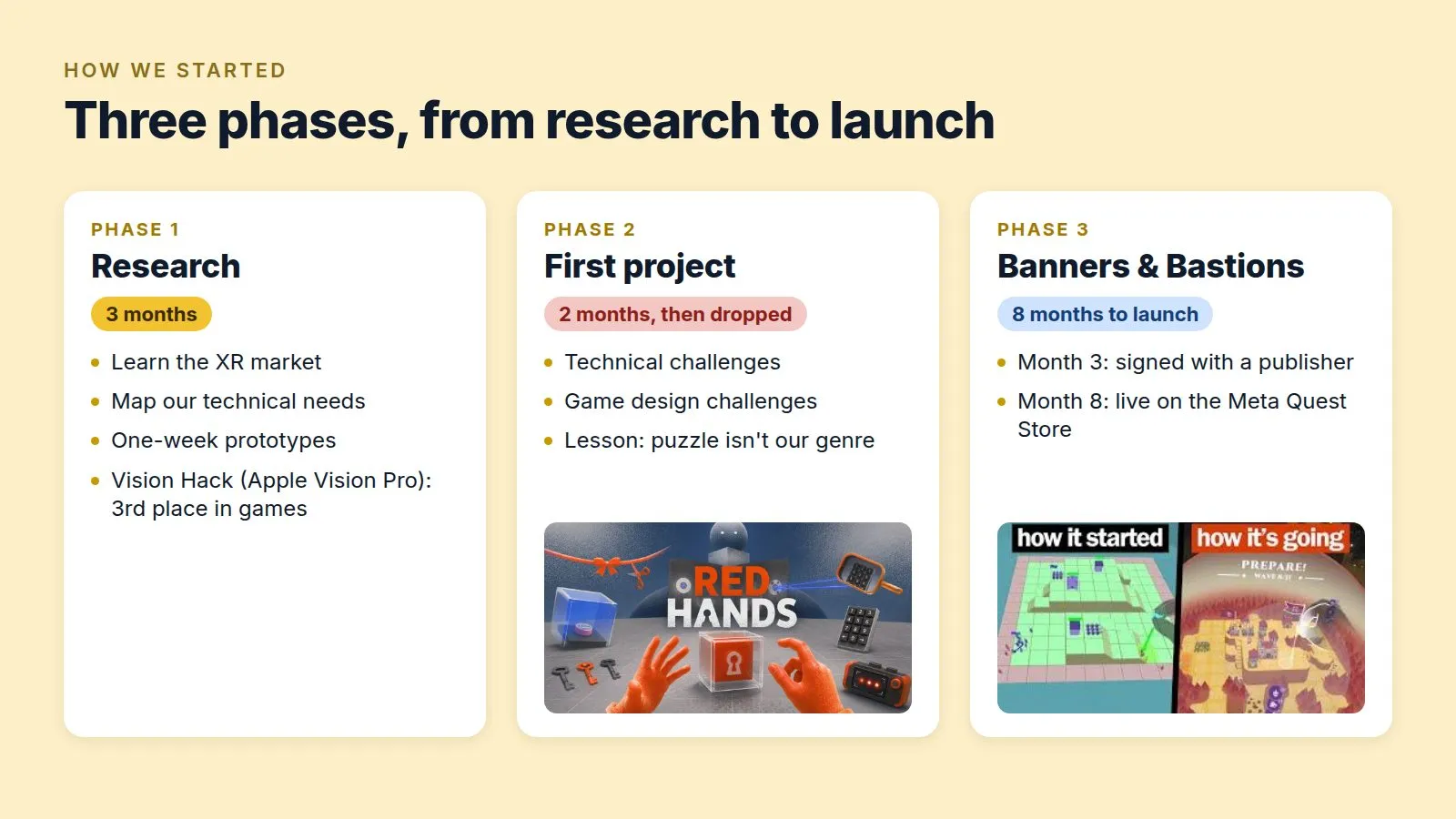
Our pivot had three phases.
Phase 1: Research (3 months)
We started with research. It took us three months to understand the XR market: which titles succeed, what trends are forming, how big XR companies are, and how much money they make.
Then we mapped our technical needs: the current platforms, how to use the available templates, and which features those platforms actually support.
We built one-week prototypes just to try new things. Each prototype was meant to answer one core question for our future development framework. We even entered Vision Hack, a hackathon for Apple Vision Pro, and took third place in the games category.
Phase 2: Our first project (2 months, and it failed)
Next, we started our first bigger project, Red Hands. The idea was to create items by performing their hand gestures. We thought it was a cool idea.
After two months of complex development, lots of technical difficulties, and game design obstacles, we dropped it. Our conclusion: the puzzle genre isn’t right for our team.
Phase 3: Banners & Bastions (8 months to launch)
For the third phase, we started a new mixed reality title. We mixed inspiration from successful games like Bad North, Thronefall, and Kingdom Rush, plus Airspace Defender, another mixed reality game. Back then, we simply called it “island-game”. Today it’s Banners & Bastions.
Three months in, we found the best and most helpful publisher we could have asked for: Not Suspicious, the publisher of Airspace Defender. (What a coincidence. More on how that happened below.) Eight months after we started, the game was live on the Meta Quest Store.
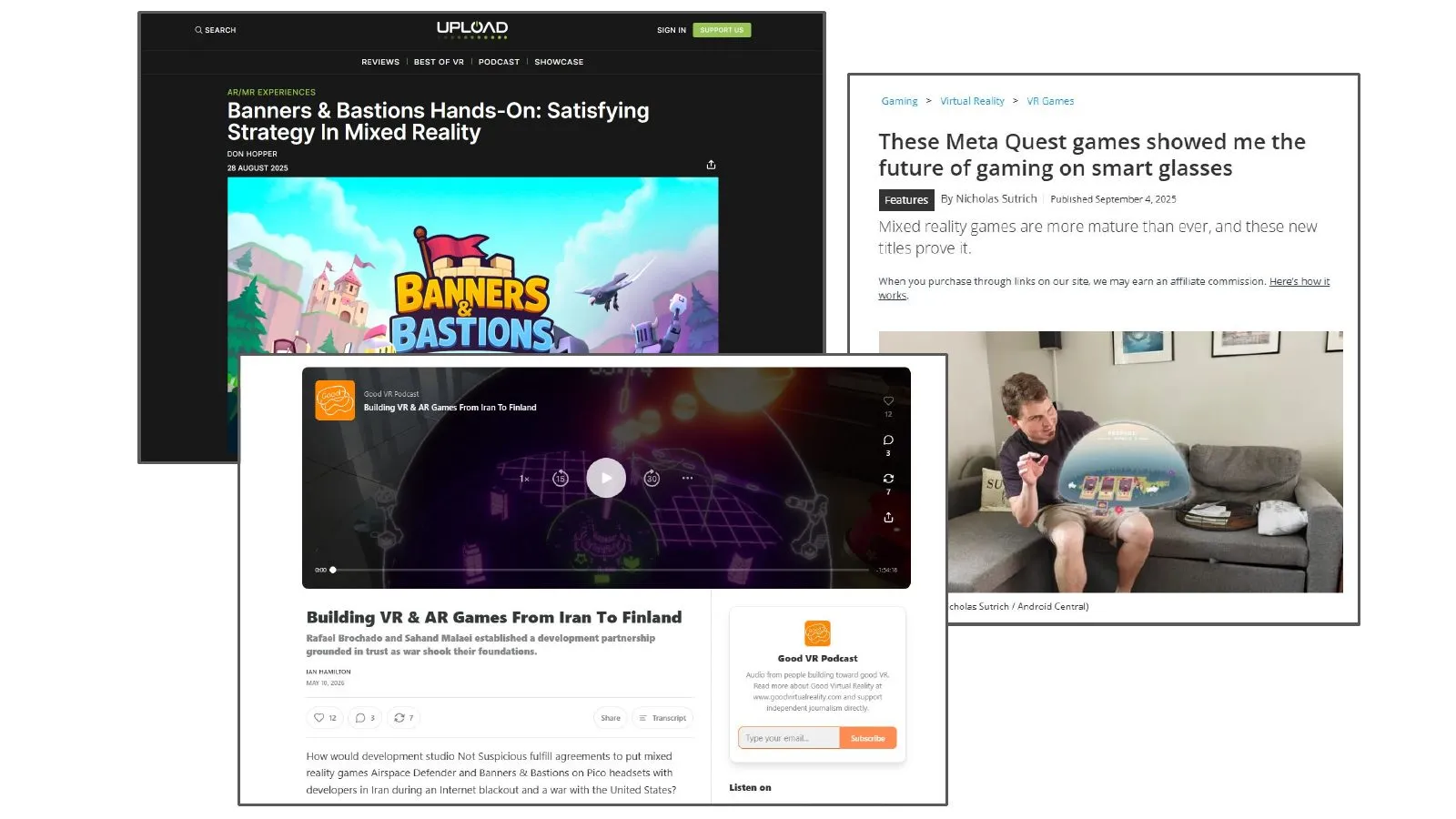
The game also caught the attention of the XR press. UploadVR published a hands-on calling it “satisfying strategy in mixed reality”, Android Central included it among the Meta Quest games that showed the future of gaming on smart glasses, and the Good VR Podcast told our story in “Building VR & AR Games From Iran to Finland”.
What we learned
One message can change your path
In the early stages of Banners & Bastions, a single message completely changed our path.
To publish a game, you usually need a pitch deck, a vertical slice and a publisher who says yes. We had planned to do all of that later. But then we sent a message to a team member of Airspace Defender, one of the games that inspired us. Out of nowhere, they were interested in publishing our game.
Go to game events. Talk to as many people in the industry as you can. You never know what a single connection can bring you.
Pay attention to the signs
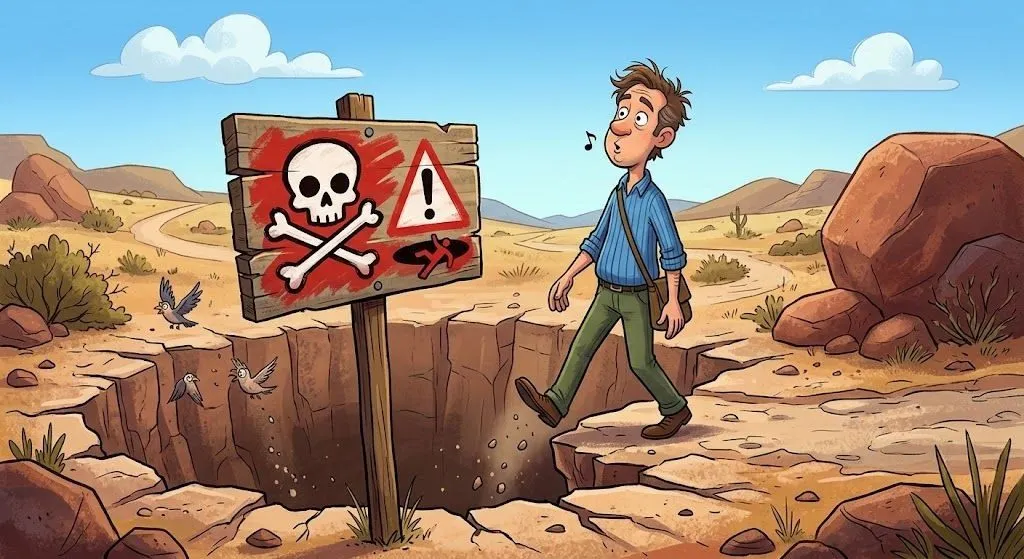
There are always signs. Always. The problem is that they aren’t visible enough until it’s too late, and then they seem to have been visible the whole time.
On Last Survivor, our big mobile project, we saw the signs of failure and ignored them. After four months of development, it was clear the project wouldn’t succeed. We kept going for more than a year before we finally dropped it.
Seeing the signs is hard. Try your best to see them anyway.
Let someone else set your deadlines
One of the things that kept us on track was the external deadlines our publisher set for us. He would sign us up for a showcase, then tell us we had a month to make a trailer.
Meeting those deadlines was hard. It was absolutely worth it.
Keep going, even without motivation
Talking about staying motivated and hopeful feels like a cliché here, because I wasn’t motivated most of the time.
Only one thing kept me going: the act of continuing itself. Doing what you have to do, even when there’s no reward and no hope, and not doing it to get anything back. Just doing it to keep doing something.
Where we are now
Earlier this year, we moved the studio from Iran to Finland, where Exir Games is now based. Banners & Bastions has passed 15,000 users and holds a 4.8-star rating on the Meta Quest Store.
When I say we saved the studio, I mean it survived. The hard part isn’t over, but we’re still here, still making games, and now we build them on a platform where our team’s creativity can actually be seen.
Three things you must do
If you take one thing from our story, take these three:
- Research the market thoroughly before you enter it. Learn which games succeed, what’s trending, and what the platform can actually do.
- Drop your first projects. Throwing away early ideas makes room for better ones to grow. We dropped Red Hands after two months, and Banners & Bastions came next.
- Build step by step. Move forward little by little, instead of trying to finish everything in one big leap.
You can find more of our studio at exir.games, and Banners & Bastions on the Meta Quest Store.